
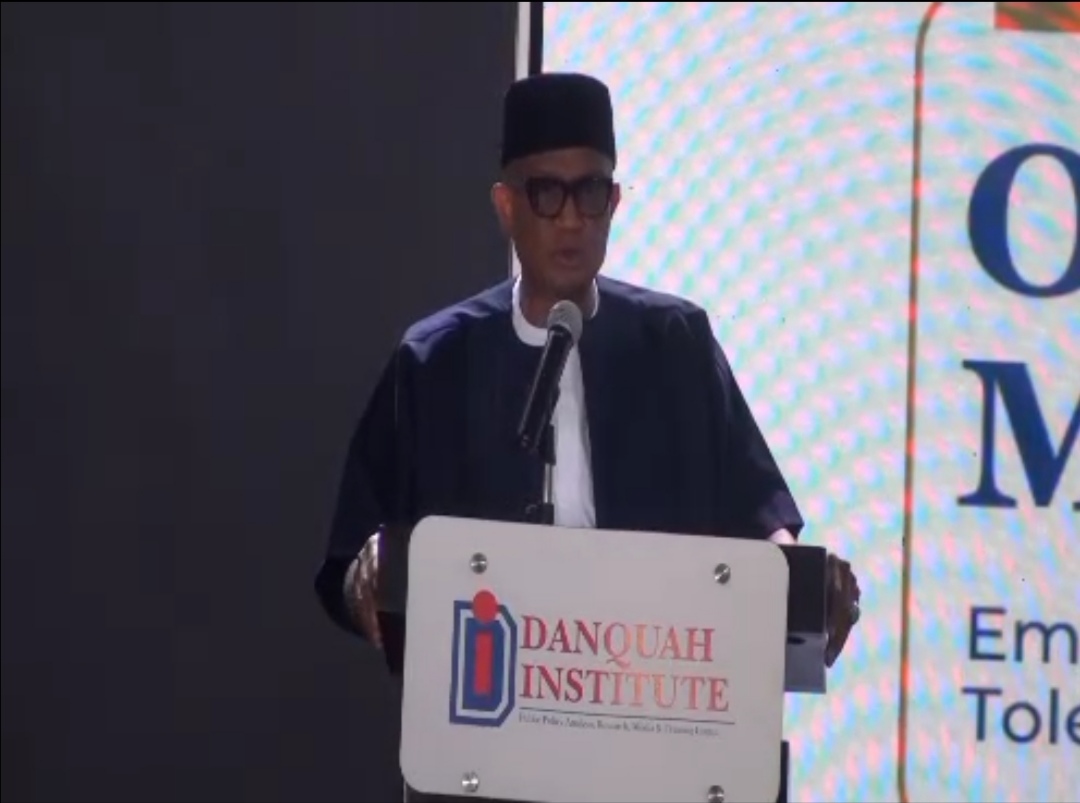
Former Minister for Information and former Chief Executive of the National Petroleum Authority (NPA), Dr. Mustapha Abdul-Hamid, has condemned persons peddling religious bigotry against former Vice President Dr. Mahamudu Bawumia.
Speaking as Guest Speaker at the Danquah Institute 2026 Liberty Lecture at the Alisa Hotel in Accra, on the theme “One Nation, Many Faiths: Emerging Threats to Religious Tolerance in Ghana,” Dr. Abdul-Hamid said it is false and dangerous for anyone to claim that electing Dr. Bawumia would lead to the introduction of Sharia law in Ghana.
“Dr. Mahamudu Bawumia is seeking the presidency of Ghana not to reorder the religious destiny of our country. His lifelong occupation has been about finding solutions for the health of economies and nations,” he stated.
He noted that Dr. Bawumia’s education and career path – from Zimbabwe to Oxford University to the Bank of Ghana and to the Vice Presidency – has been centered on economics, adding that his major interventions as Vice President such as medical drone delivery, the National Identification System and the Gold-for-Oil programme, have benefited all Ghanaians regardless of faith.
He emphasize that Adam Smith propounds theories for the health of nations. He doesn’t propound theological theories for reordering the religious destinies of societies,” he argued.
Dr. Abdul-Hamid also defended President John Mahama’s proposals to introduce Arabic as an optional subject at the basic level and to introduce interest-free banking, stating that it does not amount to an attempt to Islamize Ghana.
“President Mahama believes in the grace of Christ and is a member of the Assemblies of God Church. How anybody would conceive that he would endorse an agenda to Islamize Ghana beats my imagination,” he said.
He stressed that Arabic is a language distinct from Islam, noting that Arab Christians also speak Arabic and refer to God as Allah. “Introducing Arabic as a subject of study is an essential part of producing global citizens. It is noteworthy that Arabic is being introduced alongside Mandarin,” he explained.
According to him, Arabic is the most widely spoken language on the African continent, followed by Swahili, English and French. Worldwide, it is spoken by hundreds of millions, and learning it alongside languages like Mandarin and French should be seen as a strategic socio-economic investment, not a religious agenda.
“In any event, the top five Muslim-majority countries with a combined population of 932 million – Indonesia, Pakistan, India, Bangladesh and Nigeria – do not speak Arabic,” he added.
He argued that the 22 member states of the Arab League constitute a $4 trillion economic bloc, and Arabic proficiency could open doors for Ghanaian students, diplomats, entrepreneurs and professionals in scholarships, trade and investment.
“Teaching Arabic should no more be regarded as an attempt to Islamize our schools than teaching French is considered an attempt to convert Ghana into a French colony. Language is an economic tool,” he stated.
On interest-free banking, Dr. Abdul-Hamid clarified that it was not introduced by Prophet Muhammad, citing that Aristotle between 384 BC and 322 BC had long argued against usury.
The lecture was attended by former President Nana Addo Dankwa Akufo-Addo, former Vice President Dr. Mahamudu Bawumia, former ministers, former Members of Parliament and other members of the NPP.